
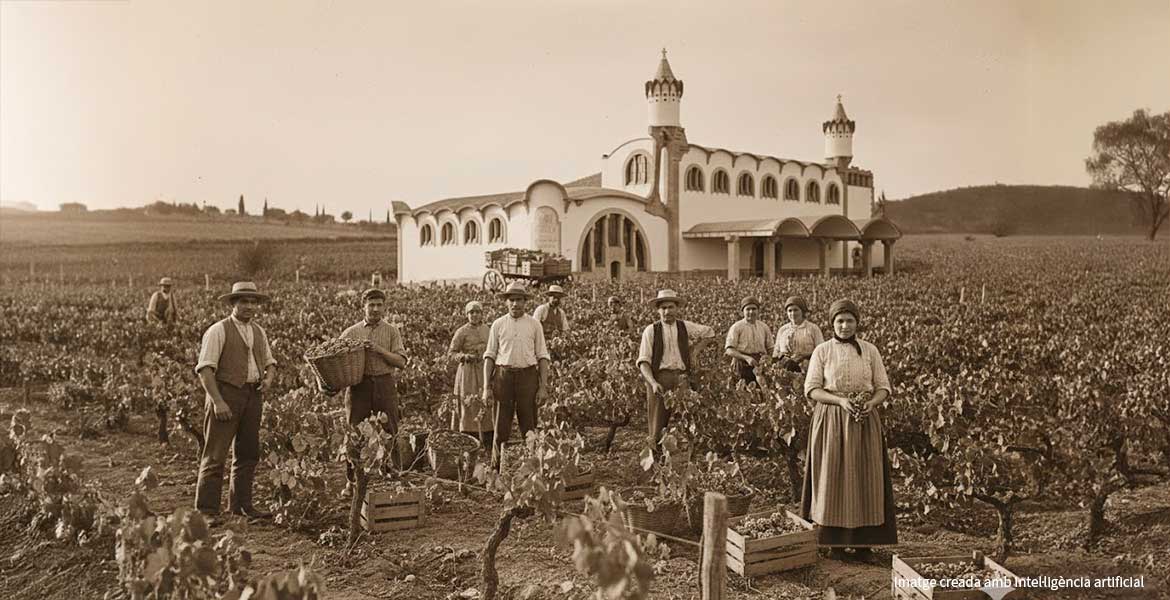
If today you look at Gandesa through the lens of wine tourism, it is easy to be left with the postcard: the capital of the Terra Alta, the road junction, the Mediterranean landscape and, above all, that building that looks more like a cathedral than a winery. But in 1919, Gandesa was not a postcard. It was a decision.
At the beginning of the 20th century, the town was coming from a very hard blow: phylloxera had devastated the vineyards (in Gandesa, in 1901) and farmers had to replant with American rootstock in order to raise production again. That effort, however, required infrastructure: wineries were needed, organization was needed, and a way was needed not to be left at the mercy of every crisis.
Gandesa also carried a very telling demographic reality: after reaching its population peak in 1900 (3,767 inhabitants), it had begun a downward curve. In other words: the countryside pushed, but life was complicated and emigration was a real threat. In this context, agricultural cooperativism was not a fashion: it was a tool to endure.
And this is where 1919 comes in.
That year, 48 families from the village founded the cooperative (the “Syndicate”) with entry conditions that explain very well the mentality of the time: being from the village, contributing 20 pesetas and land (or work, if they did not have any), and even meeting a physical requirement (weighing more than 50 kilos) to avoid child labor. It is not just an anecdote: it is the portrait of a community that wanted to move forward with adult hands, commitment and shared responsibility.
The creation of the cooperative meant, above all, three things.
The first: the ability to do what a single farmer could hardly do alone. The first members mortgaged land and properties to request a loan from the Bank of Valls. This is the key word: credit. Collective financing to build a collective infrastructure.
The second: a technical and productive leap. In 1919, the Gandesa Agricultural Cooperation Syndicate commissioned the cooperative winery and the olive oil mill from the architect Cèsar Martinell, within that movement of cooperativism and agrarian associationism which, in Catalonia, had been strengthened as a response to the crisis and as a new way of organizing the rural world. In addition, the context of the Mancomunitat (1914–1923) was especially favorable for the promotion of this type of initiative throughout the country.
The third: collective identity and self-esteem. It was not just about “having a winery”, but about asserting the farming community and local vitiviniculture. The project was built thanks to the union of these 48 families; the works were completed in January 1920 and wine production even began before everything was fully ready. This haste was not improvisation: it was an urgency of life.
The building, moreover, was born with a practical intelligence that explains why it still impresses today. Martinell avoided wood in the roof because it had become more expensive as a result of the First World War and opted for a solution with a Catalan vault (functional, modern and beautiful). It is not just architecture: it is applied economics, ingenuity put at the service of the countryside.
Seen in perspective, the Cooperative was a way of organizing the future at a time of uncertainty. It gave structure to production, made it possible to invest in quality and processes, strengthened the ability to market, and created a symbol: a physical place where the work of many took on a single form. And, above all, it turned a group of farmers into an organized community.
That is why, when people speak of 1919 in Gandesa, they are really speaking of a very simple and very powerful idea: that the strength of a territory is not only the grape or the land, but the shared decision not to throw in the towel. That is why we say that we are “Proudly nonconformist since 1919.”